
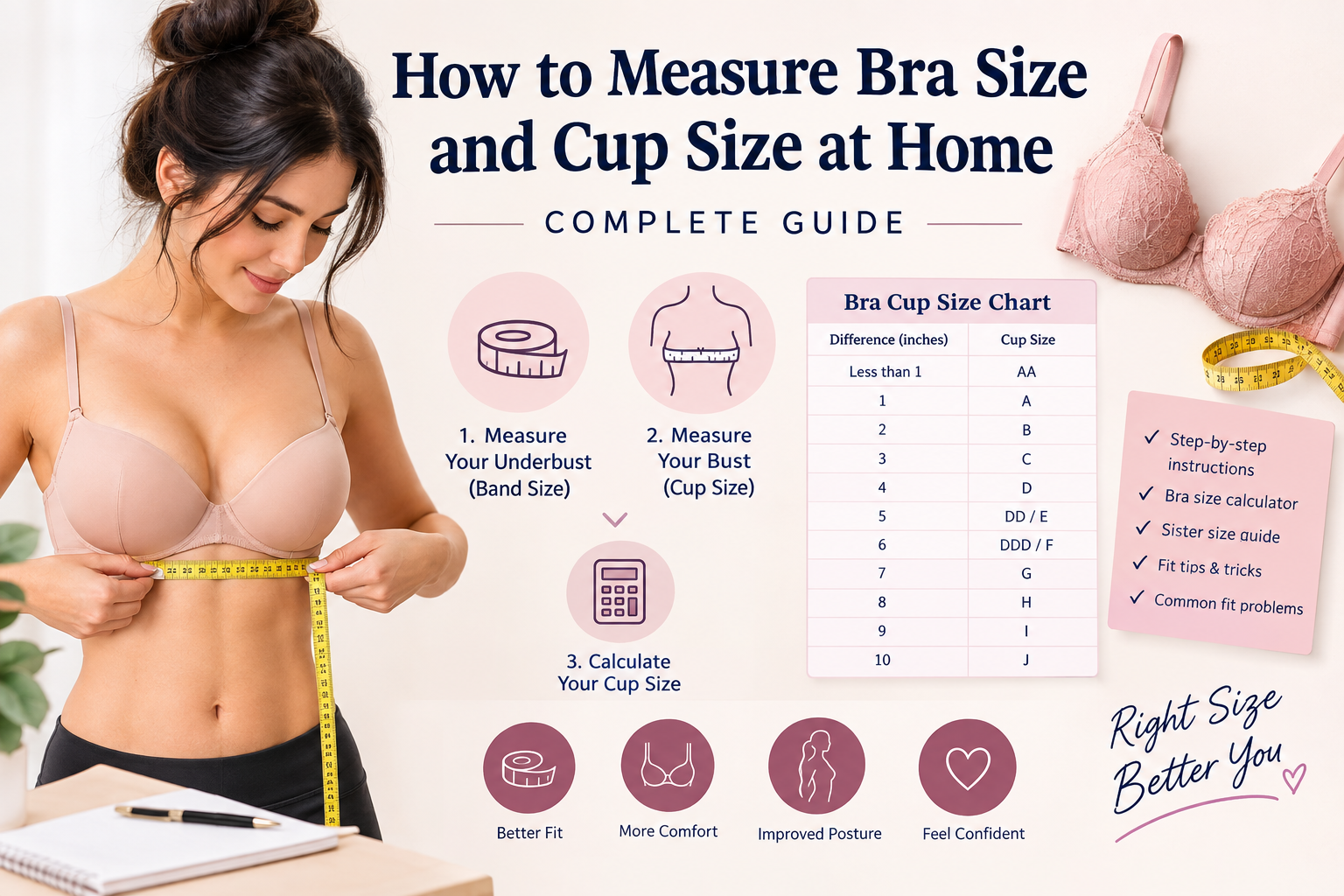
How to Measure Bra Size and Cup Size at Home: The Complete Guide
Finding the right bra size shouldn’t require trying on dozens of bras or guessing between different cup letters.
If your bra band rides up, your straps constantly slip, the cups gap, or your breasts spill over the top, the problem may simply be that you’re wearing the wrong size or the wrong bra shape.
The good news is that you can get a useful starting size at home with a soft measuring tape and two measurements: your underbust and your bust.
This guide explains exactly how to measure bra size, how to calculate your cup size, how sister sizes work, how to recognize common fit problems, and why your breast shape can affect which bra style works best.
Quick answer: Measure your under bust snugly to determine your band size. Then measure the fullest part of your bust and subtract your band size from your bust measurement. The difference gives you a starting cup size.
Quick Bra Size Calculator
Before going through the complete guide, you can use a bra size calculator to get a quick starting point.
You need:
- Your under bust measurement
- Your fullest bust measurement
- Your preferred sizing system, such as US or UK
Basic formula:
Bust measurement − band size = cup size difference
For example:
- Under bust: 32 inches
- Bust: 36 inches
- Difference: 4 inches
- Starting size: 32D
Remember that this is a starting size, not a guarantee of perfect fit. Brand sizing, bra construction, breast shape, and tissue distribution can all affect how a bra fits.
What Measurements Do You Need to Calculate Bra Size?
You only need two main measurements to calculate a starting bra size:
1. Under bust measurement
This is the measurement directly underneath your breasts, around your ribcage.
It helps determine your band size.
2. Bust measurement
This is the measurement around the fullest part of your breasts.
It helps determine your cup size.
The difference between these measurements is then used to estimate your cup letter.
What You Need Before Measuring Your Bra Size
You don’t need special equipment to measure yourself.
Gather:
- A flexible fabric measuring tape
- A mirror
- A thin, unpadded bra or bare skin
- Your phone or a piece of paper to record the measurements
Avoid using a rigid metal measuring tape because it doesn’t follow the natural curves of your body.
For the most consistent results, stand naturally and avoid pulling your stomach in, holding your breath, or changing your posture while measuring.
Step 1: Measure Your Under bust
Your under bust measurement is the foundation of your bra size.
How to measure your under bust
- Stand upright with your arms relaxed.
- Place the measuring tape directly underneath your breasts.
- Make sure the tape sits where the bottom of your bra band normally rests.
- Check the mirror to make sure the tape is horizontal all the way around your body.
- Pull the tape snugly but comfortably around your ribcage.
- Breathe normally rather than holding your breath.
- Record the measurement in inches.
The tape should be firm enough to stay in place but shouldn’t make breathing uncomfortable.
How to determine your band size
For the sizing method used in this guide:
- An even measurement can be used as your starting band size.
- An odd measurement is generally rounded up to the next even number.
- Half-inch measurements can also be rounded up to the next whole/even starting band size.
Example
If your under bust measures:
32 inches → 32 band
If it measures:
33 inches → 34 band
If it measures:
31.5 inches → 32 band
Important: Bra sizing isn’t completely standardized between brands. Always compare your calculated size with the specific brand’s size chart when one is available.
Step 2: Measure Your Bust
Now measure around the fullest part of your breasts.
This measurement is sometimes called the overbust measurement.
How to measure your bust
- Stand naturally in front of a mirror.
- Wrap the measuring tape around the fullest part of your breasts.
- Keep the tape horizontal across your back.
- Don’t pull the tape tightly.
- Make sure the tape rests against your body without compressing your breast tissue.
- Breathe normally.
- Record the measurement.
The goal is to measure the natural circumference of your bust rather than squeezing or flattening the tissue.
What should you wear while measuring?
A thin, unpadded bra can work well because it keeps the breasts in a natural supported position without adding artificial volume.
Avoid heavily padded, push-up, or molded bras because they can change the measurement.
If your current bra significantly changes the shape of your breasts, measuring without a bra may provide a better starting point.
Step 3: Calculate Your Cup Size
Now you have the two numbers needed to estimate your starting cup size.
Use this formula:
Bust Measurement − Band Size = Cup Size Difference
For example:
Bust: 36 inches
Band: 32 inches
36 − 32 = 4 inches
A 4-inch difference corresponds to a starting D cup in the simplified chart below.
Bra Cup Size Chart
| Difference | Starting Cup Size |
|---|---|
| Less than 1 inch | AA |
| 1 inch | A |
| 2 inches | B |
| 3 inches | C |
| 4 inches | D |
| 5 inches | DD / E |
| 6 inches | DDD / F |
| 7 inches | G |
| 8 inches | H |
| 9 inches | I |
| 10 inches | J |
Example:
Under bust: 31 inches
Rounded band: 32
Bust: 36 inches
36 − 32 = 4 inches
Starting bra size:
32D
This calculation gives you a useful starting point, but your final best-fitting bra may differ because bra sizing varies between brands and styles.
Why Your Cup Size Isn’t a Fixed Breast Size
One of the biggest misunderstandings about bra sizing is thinking that a cup letter represents one universal breast volume.
It doesn’t.
A 32C and a 38C do not have the same cup volume.
The cup letter describes the relationship between the cup and the band size. As the band gets larger, the cup volume associated with the same letter also changes.
That’s why simply saying “I’m a C cup” doesn’t tell you the complete bra size.
You need both numbers:
Band + Cup
For example:
- 32C
- 34C
- 36C
These are different bra sizes even though they all contain the letter C.
What Are Sister Sizes?
Sister sizes are bra sizes with similar cup volume but different band measurements.
They’re especially useful when your calculated size feels close but the band doesn’t feel right.
For example:
34D → 32DD → 36C
These are sister sizes.
If the band feels too loose
Go down one band size and up one cup size.
Example:
34D → 32DD
If the band feels too tight
Go up one band size and down one cup size.
Example:
34D → 36C
Sister sizing can help you find a more comfortable fit, but it shouldn’t be used to compensate for a major cup or shape mismatch.
Why Two People With the Same Bra Size May Need Different Bras
Measurements are only one part of bra fitting.
Breasts vary in:
- Shape
- Projection
- Root width
- Fullness
- Tissue softness
- Left-to-right symmetry
This means two people who both measure 34C may prefer completely different bra styles.
Full on Bottom
If most of your breast tissue is below the nipple line, you may find that certain demi, plunge, or balconette styles work better than very tall cups.
Full on Top
If you have more tissue above the nipple line, a suitable balconette or fuller-coverage style may provide better containment.
Shallow Breasts
Shallow breasts tend to spread across a wider area of the chest rather than projecting significantly forward.
Some shallow shapes work better with cups designed for a wider, flatter profile.
Projected Breasts
Projected breasts extend farther forward from the chest wall.
A deeper cup, particularly one with multiple seams, may provide a better fit than a shallow molded T-shirt cup.
Asymmetrical Breasts
It’s completely normal for one breast to be slightly larger than the other.
When choosing a bra, fit the cup to the larger breast rather than forcing both sides into the smaller measurement.
Adjustable straps or removable inserts can help balance the smaller side.
How to Tell If Your Bra Fits Correctly
After calculating your size, don’t stop at the number.
The real test is how the bra behaves on your body.
Look at these key areas.
1. The Band
The band should sit relatively level around your body rather than riding up your back.
It should feel supportive without making breathing uncomfortable.
A new bra should generally be comfortably secure on the loosest hook, giving you room to tighten it as the elastic stretches with use.
2. The Cups
Your breasts should sit comfortably inside the cups without obvious spilling or large empty spaces.
Watch for:
- Breast tissue spilling over the cup
- Wrinkled cups
- Large gaps
- Cups cutting into breast tissue
- Underwires sitting on breast tissue
3. The Center Gore
The center section between the cups should sit appropriately against your breastbone for the bra style.
If it is being pushed significantly away from your chest, the cup may be too small or the bra may not suit your breast shape.
4. The Underwire
The underwire should surround the breast tissue rather than sitting directly on it.
It should follow your breast root without digging painfully into the sides.
5. The Straps
Shoulder straps should provide adjustment and stability, but they shouldn’t be doing all the work.
If you constantly need to tighten them to keep your bra in place, check the band and cup fit first.
Common Bra Fit Problems and How to Fix Them
| Bra Fit Problem | Possible Cause | What to Try |
|---|---|---|
| Band rides up | Band may be too loose | Try a smaller band with a corresponding sister cup |
| Breast spills over the cup | Cup may be too small | Try a larger cup |
| Underwire digs into breast tissue | Cup or wire shape may be wrong | Try a larger cup or different wire shape |
| Cup gaps | Cup may be too large or too tall | Try a smaller cup or different cup shape |
| Straps keep slipping | Band may be too loose or straps too wide | Check band fit and adjust straps |
| Center gore doesn’t sit correctly | Cup may be too small or style may not suit you | Try another cup size or bra shape |
| Cups wrinkle | Cup shape may not match your breast shape | Try another style or cup construction |
A fitting problem doesn’t always mean you need a completely different size. Sometimes the bra style is the issue.
How to Put on a Bra Correctly: The Scoop and Swoop Method
Even a correctly sized bra can appear to fit incorrectly if your breast tissue isn’t positioned properly inside the cups.
Try the scoop and swoop method.
Step 1: Put on the bra
Hook the bra on the loosest comfortable setting.
Step 2: Lean slightly forward
Bend forward enough for your breast tissue to naturally move toward the cups.
Step 3: Scoop the tissue
Use your hand to gently move tissue from underneath and around the sides toward the center of the cup.
Step 4: Stand upright
Return to a normal standing position.
Step 5: Adjust the cups
Make sure the breast tissue is comfortably contained and the underwire follows the breast root.
Step 6: Adjust the straps
Tighten or loosen the straps until they stay comfortably in place without digging into your shoulders.
This process can make a surprisingly large difference when evaluating bra fit.
Should You Use the +4 Bra Sizing Method?
You may see older bra-sizing guides recommending that you add four inches to your underbust measurement before calculating your band size.
This is commonly called the +4 method.
Modern bra fitting discussions often use a more direct approach, especially with stretch fabrics.
Instead of automatically adding four inches, start with your actual snug underbust measurement and compare your result with the manufacturer’s size chart.
Why can online bra calculators give different answers?
Different calculators may use different:
- Band-size formulas
- Rounding rules
- Cup progression systems
- Brand-specific sizing standards
- Measurement techniques
That’s why your calculated size should be treated as a starting point rather than an absolute answer.
US vs UK Bra Sizes
Bra sizing systems aren’t identical across countries.
One of the most important differences appears in the cup progression.
For example, UK sizing commonly uses:
D → DD → E → F → FF → G → GG
US sizing can use a different progression, particularly after D.
This becomes important when shopping from international brands.
If a brand provides a specific sizing chart, use that chart instead of assuming that the same cup letter means exactly the same thing across every country.
How Often Should You Measure Your Bra Size?
Your bra size can change over time.
You may want to re-measure when you experience:
- Significant weight change
- Pregnancy
- Breastfeeding or weaning
- Major changes in exercise or muscle development
- Aging-related body changes
- Noticeable changes in how your current bras fit
Rather than relying on a measurement from several years ago, recheck your size whenever your body or bra fit changes noticeably.
Frequently Asked Questions About Bra Size
How do I measure my bra size at home?
Measure your underbust snugly around your ribcage and your bust around the fullest part of your breasts. Use the underbust to establish a starting band size, then subtract the band size from the bust measurement to estimate the cup size.
How do I calculate my cup size?
Subtract your band size from your fullest bust measurement.
Bust − Band = Cup Difference
The resulting number can then be compared with a cup-size chart.
What if my measurements fall between two sizes?
Try the closest sizes and compare the fit. You can also consider sister sizes when the band feels too tight or too loose.
Is a C cup the same size for every woman?
No. Cup size is relative to band size. A 32C and 38C have different cup volumes.
Should I measure my bust with a bra on?
A thin, unpadded bra can be useful if it doesn’t change your natural shape significantly. Avoid heavily padded or push-up bras because they can affect the measurement.
Why does my bra band ride up?
A band that rides up your back is often too loose. However, an incorrectly sized cup can also affect how the band behaves. Check the entire fit rather than changing only one measurement.
Why do my bra cups gape?
Gapping can happen when the cup is too large, but it can also occur when the cup shape doesn’t match your breast shape. Molded cups can be particularly unforgiving if your natural shape doesn’t match the cup’s contour.
Why does my bra cause breast spillage?
Spillage usually indicates that the cup doesn’t provide enough room or that the cup shape isn’t suitable for your breast tissue. Try a larger cup or a different bra style.
What is a sister size in bras?
A sister size is a bra size with a different band and cup letter but a similar overall cup volume. For example, 34D, 32DD, and 36C are commonly treated as sister sizes.
Can breast shape affect bra size?
Your measurements determine a starting size, but breast shape affects which bra styles fit best. Two people with identical measurements may need different cup shapes or wire widths.
The Bottom Line: Your Bra Size Is a Starting Point
Learning how to measure bra size at home is much easier once you understand what the numbers actually represent.
Start with two measurements:
1. Underbust → Band size
2. Bust → Cup difference
Then combine them to get your starting bra size.
For example:
32 band + D cup = 32D
But don’t assume that the number alone guarantees a perfect fit. Your breast shape, projection, tissue distribution, the bra’s construction, and the brand’s sizing system can all affect the final result.
If a bra doesn’t fit correctly, don’t immediately assume that your body is the problem.
Try adjusting the band, cup, sister size, or bra style until you find the combination that supports you comfortably.
Ready to calculate your size?
Use our Bra Size Calculator to enter your measurements and get your starting bra size.
Related Bra-Fitting Guides
For a complete bra-sizing resource, build a connected group of articles around this guide:
- Bra Size Calculator
- How to Measure Bust and Underbust
- How Do Sister Sizes Work?
- US vs UK Bra Size Conversion Chart
- How Should a Bra Fit?
- Why Does My Bra Ride Up?
- Why Do My Bra Cups Gap?
- Why Is My Bra Digging Into My Shoulders?
- How to Find the Right Bra for Your Breast Shape
- Bra Size After Weight Loss
- How Does Pregnancy Change Bra Size?
- How to Measure for a Sports Bra
- How to Measure for a Strapless Bra
- Bra Size Conversion Chart
- Common Bra Fitting Mistakes
These pages should link naturally to one another rather than existing as isolated articles. This creates a stronger topical structure around bra sizing, measurement, fit, breast shape, bra styles, and size conversion.